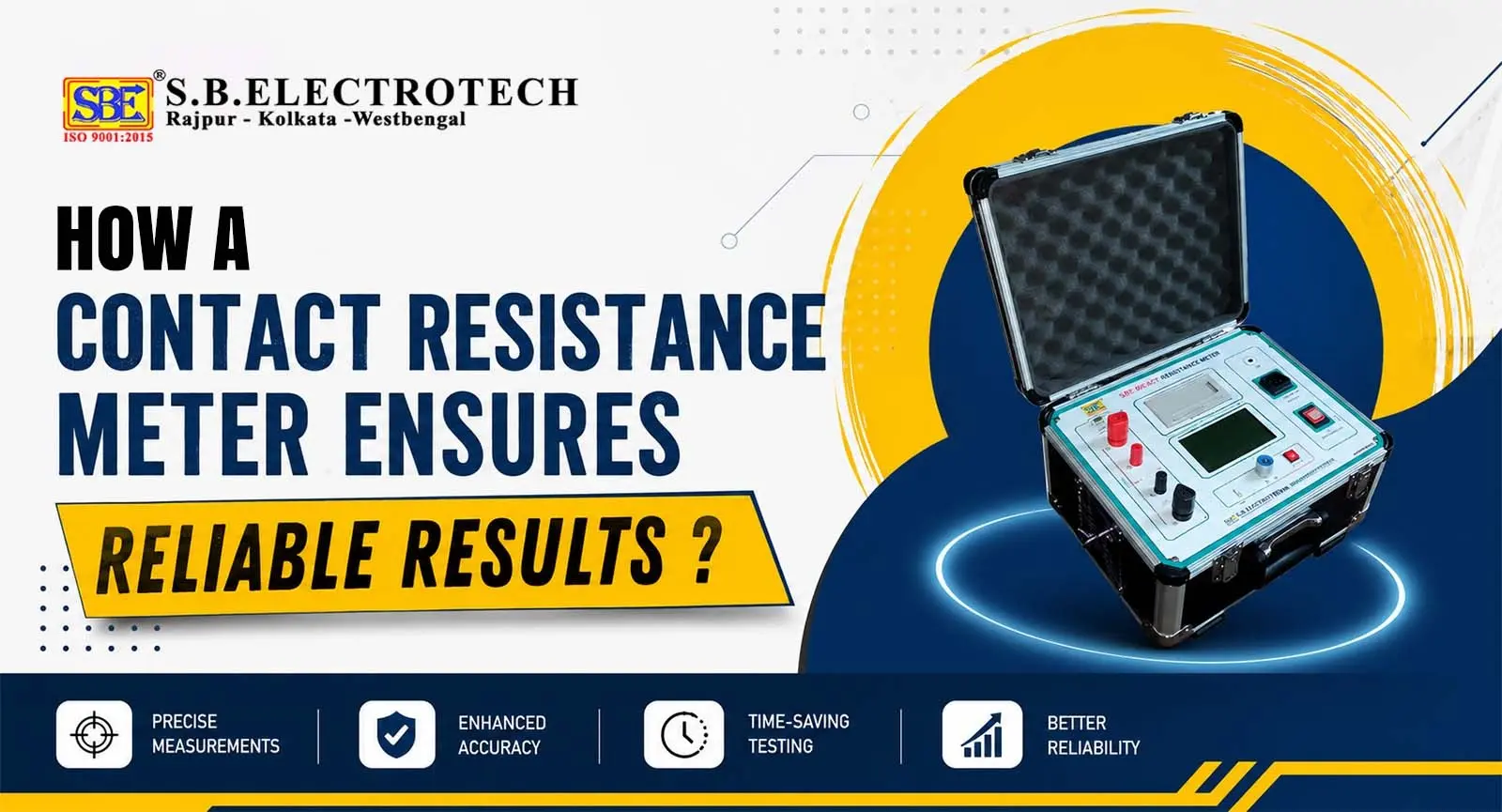
Electrical connections that look fine from the outside are not always fine on the inside. Corrosion builds up. Contacts wear. Joints loosen over time. None of it is visible during a routine inspection, but all of it shows up in the resistance reading when you measure it properly.
That is what a contact resistance meter is for. It finds the problems that visual checks miss before those problems cause equipment failure, tripped breakers, or unplanned downtime. For anyone responsible for maintaining electrical systems in power, industrial, or substation environments, understanding how this instrument works and when to use it matters more than most people initially give it credit for.
What Contact Resistance Actually Means?
Every electrical connection has some resistance. That is unavoidable. What matters is whether the resistance is within an acceptable range for the equipment and the current it carries.
When resistance at a contact point rises above that acceptable range, things start to go wrong. The connection generates more heat than it should. Over time, that heat accelerates deterioration, which raises the resistance further, which generates more heat. It is a cycle that ends in failure if it is not caught early.
Contact resistance is measured in micro-ohms. The values involved are very small, which is exactly why standard multimeters are not suitable for the job. You need an instrument built specifically for measuring at that level of precision.
How a Contact Resistance Meter Works?
The operating principle is based on the four-terminal measurement method, also called the Kelvin method. This is worth understanding because it is what separates accurate contact resistance measurement from unreliable results.
In a standard two-terminal measurement, the resistance of the test leads themselves gets included in the reading. At micro-ohm levels, that lead resistance is significant enough to completely distort the result.
The four-terminal method solves this by separating the current-carrying function from the voltage-sensing function. Two terminals inject a known DC current through the contact being tested. Two separate terminals measure the voltage drop across that same contact. Because the voltage-sensing circuit draws virtually no current, the resistance of those leads does not affect the reading.
The instrument then applies Ohm’s law. Resistance equals voltage divided by current. The reading reflects the contact resistance only. Test leads and the surrounding circuit contribute nothing to it. SB Electrotech displays the result on an LCD or LED screen.
Clear, on-site, and straightforward to log into a maintenance record without second-guessing the number. The compact, portable design means the instrument travels to the equipment rather than the other way around.
Models Available
SB Electrotech manufactures four models of contact resistance meter, each suited to different measurement requirements.
- CRM 100 is the standard model, built for field use across a wide range of electrical contact testing applications. Compact, accurate, and straightforward to operate.
- CRM 100P adds a built-in printer to the standard CRM 100 functionality. Test results print directly from the instrument, which simplifies on-site documentation and reduces the risk of transcription errors in maintenance records.
- CRM 200 delivers higher test current output for applications where more demanding measurement conditions require it. Suitable for larger contacts and heavier-duty equipment where the CRM 100 range may not be sufficient.
- CRM 200P combines the higher current capability of the CRM 200 with the built-in printer of the 100P. For teams that need both higher test capacity and on-site documentation, this is the model that covers both.
Where Contact Resistance Meters Are Used?
Power distribution and substations
Circuit breakers, disconnectors, busbars, and switchgear contacts all require periodic contact resistance testing. A circuit breaker that operates correctly mechanically but has high contact resistance will generate excessive heat during normal operation and may not interrupt fault current reliably when it matters.
Transformer maintenance
Tap changer contacts and bushing connections are tested for contact resistance as part of routine transformer maintenance. Deterioration at these points affects transformer performance and can accelerate insulation breakdown if left unchecked.
Industrial machinery
Large motors, switchboards, and control panels carry significant current through their connections. Regular contact resistance testing identifies joints and terminals that are starting to deteriorate before they cause equipment trips or damage.
Railway and traction systems
Current collectors, rail bonds, and overhead line connections in traction systems carry very high currents. Contact resistance testing is part of the standard maintenance regime for these systems because the consequences of a high-resistance joint in service are serious.
Relay and protection testing
Relay contact resistance affects the reliability of protection systems. Testing ensures that protection contacts will operate correctly when needed, which is the whole point of having them.
Why It Matters More Now Than It Used To?
Electrical infrastructure is ageing in many parts of the world. Equipment that was installed decades ago is still in service, often carrying loads it was not originally designed for. The contacts in that equipment have been through years of thermal cycling, mechanical operation, and environmental exposure.
At the same time, the consequences of electrical failures have become more significant. Production lines are more automated and more sensitive to power quality issues. Substations serve larger and more densely connected loads. Protection systems are expected to operate faster and more reliably than ever.
Regular contact resistance testing sits at the intersection of these two trends. It is a practical, cost-effective way to identify deterioration before it becomes a failure in equipment that is increasingly difficult and expensive to take out of service for unplanned repairs.
Wrapping Up
A contact resistance meter does a straightforward job. It finds problems in electrical connections that cannot be seen and cannot be found with standard test equipment. Done regularly, contact resistance testing prevents the kind of failures that are expensive to fix, disruptive to operations, and, in some cases, dangerous.
S.B. Electrotech has been manufacturing contact resistance meters and electrical testing instruments since 2010. If you want to know which model fits your maintenance requirements, get in touch with the team, and you will get help in choosing the right specification for the application.
Frequently Asked Questions
How often should contact resistance testing be carried out?
There is no single answer that fits every situation. Substation switchgear usually gets tested once a year or after each operation cycle, sometimes both. Industrial connections that are not carrying critical loads can go longer without testing. The sensible approach is to start with the equipment manufacturer's recommendations, check what the relevant sector standard requires, and build the schedule from there.
What is considered an acceptable contact resistance value?
It varies by equipment type and manufacturer specifications. The more useful approach is to compare the measured value against the manufacturer's limit and against previous readings for the same contact. A value that is within spec but trending upward is worth investigating even if it has not crossed the threshold yet.
Can a contact resistance meter be used on live equipment?
No. Contact resistance testing is carried out on de-energised equipment. The test injects its own DC current through the contact, and the equipment must be isolated before testing begins. Safety procedures for the site and the equipment apply in full.
What causes contact resistance to increase over time?
Several things cause it. Oxidation and corrosion on the contact surface. Wear from repeated mechanical operation. Bolted joints that loosen over time from thermal cycling. Contamination from the surrounding environment. In some cases, the problem starts at installation, when contacts are not torqued to the correct specification and resistance is elevated from the beginning.
Is a higher test current always better for accuracy?
Higher test current does improve measurement stability and signal-to-noise ratio at very low resistance values. For most standard contact resistance measurements, the CRM 100 range is suitable. Where contacts are large or resistance values are very low, the higher current output of the CRM 200 range gives more reliable results.