Quick Summary: A resistance meter measures how much a circuit, joint, winding, or insulation resists current. This article explains the main meter types, profiles ten manufacturers in India (SB Electrotech first), and shows how to compare them before you buy.
Table of Contents
Introduction
A transformer that fails an acceptance test, a switchgear panel running hot, an earthing pit that looks fine but isn’t: each of these problems starts with a resistance reading someone trusted. That is why a resistance meter is there in almost every electrical maintenance kit, from utility substations to factory floors. Yet the term covers very different instruments. Choosing the wrong type wastes money and skews results. Earth testers, contact meters, micro-ohm meters, and winding meters all measure resistance, but each one serves a different purpose and uses a different test current. This article lists the top ten Indian manufacturers and explains what each one is known for. You will also find the main meter types, practical checks for choosing a supplier, and answers to common buyer questions. If you are comparing makers for a purchase, this list will help you narrow the field faster.
What Separates a Good Resistance Meter From an Average One
Five points decide how useful a meter proves in daily work. These are as follows:
- Test current: Higher current gives a steadier reading on large contacts, while lower current suits small parts and cables.
- Four-wire (Kelvin) sensing: Separate current and voltage leads remove lead resistance from the result.
- Accuracy and range: Check the lowest resistance the meter resolves, such as 0.1 µΩ, not just the headline range.
- Memory and software: Stored readings and report export cut paperwork.
- Portability: Handheld units suit field rounds, while heavier 200 A units suit switchyards.
Weigh these before you look at brand names.
Top 10 Resistance Meter Manufacturers in India
This list draws on publicly available company and product details. Confirm current specifications with each maker before ordering. These are the top manufacturers of this meter in India:
1. SB Electrotech (Malanga Mouza, West Bengal)
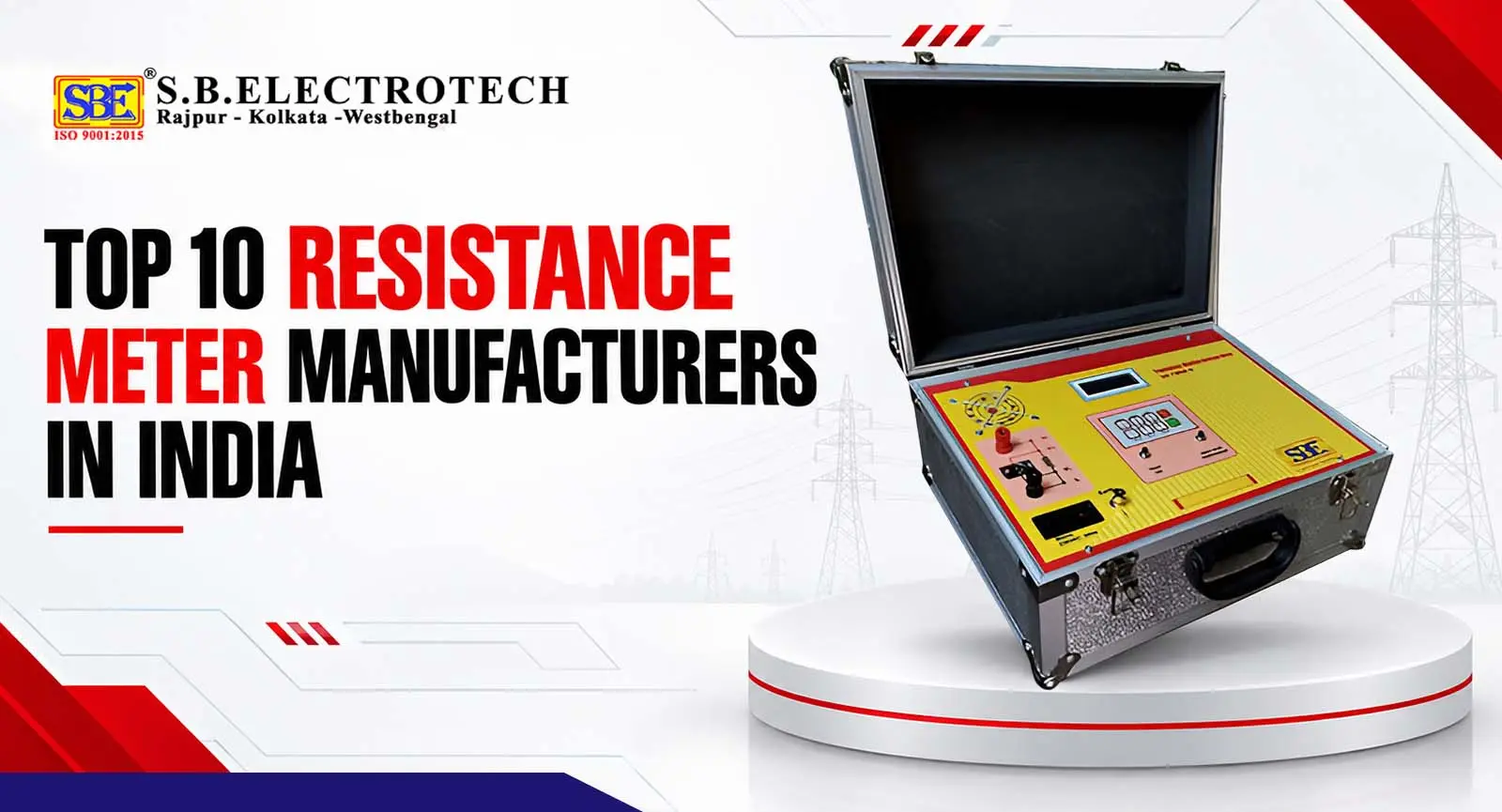
Since 2010, this Kolkata manufacturer has built electrical and electronic testing instruments. Its contact meter uses the four-point terminal method, with separate current and voltage leads. The company holds ISO 9001:2015, CE, and RoHS approvals and adds installation and servicing to its supply.
Best for: Buyers who want a resistance meter and circuit breaker timers, transformer test benches, or tan delta kits from one source.
2. SCOPE T&M (Pune, Maharashtra)
Founded in 1988, SCOPE built its name on instruments that cope with the electrical noise of EHV and UHV substations. The CRM 200B+ reads micro-ohm values at 200 A DC, even in live switchyards up to 765 kV.
Best for: Utilities testing breakers, isolators, and busbar joints in energized yards.
3. The Motwane Manufacturing Company (Nashik, Maharashtra)
The PCRM200S pushes 100 A or 200 A through the contact, relies on Kelvin four-wire sensing, and keeps 199 time-stamped records. For transformers, the XWRM-10 tests two channels at 10 A.
Best for: Teams that need on-site logging and software-based reports.
4. Prestige Electronics (Mumbai, Maharashtra)
Operating since 1985, Prestige covers a wide span, from micro-ohms to tera-ohms. Its catalogue includes micro-ohm meters, winding resistance meters, and million-ohm meters, with contact resistance models up to 200 A DC.
Best for: Labs and plants that test both low-resistance joints and high-resistance insulation.
5. Rishabh Instruments (Nashik, Maharashtra)
Rishabh Instruments began with analog panel meters in 1985. Its AMT 13 micro-ohm tester uses four-wire testing at 1 A, covers 1 µΩ to 300 kΩ, and holds 499 readings.
Best for: Quick checks on cable conductors, switch contacts, and relays.
6. Kusam-Meco (Mumbai, Maharashtra)
Active since 1983, Kusam-Meco offers a broad line of digital test instruments. The handheld KM-OHM-8502 delivers 10 A across 10 µΩ to 50 kΩ, and the KM OHM 8501 lists 0.1% accuracy in resistance meter.
Best for: Maintenance crews who want a portable meter.
7. Metravi Instruments
Metravi describes itself as one of the largest makers and distributors of resistance meters in India. Its 7272A runs on battery, measures with four wires at 10 A, resolves 0.1 µΩ, and stores 500 groups, with USB transfer.
Best for: Field technicians who log many readings per shift.
8. Meco Instruments (Navi Mumbai, Maharashtra)
Meco started in 1962 and says Indian industry has used over 6 million of its instruments. Its range includes analog and digital insulation testers.
Best for: Insulation resistance checks rather than low-resistance work.
9. Scientific Mes-Technik (Indore, Madhya Pradesh)
Established in 1963, Scientific runs a DSIR-recognised R&D lab. Its SME1202 insulation resistance meter covers 10 V to 1000 V with an analog indicator.
Best for: Labs, training institutes, and government departments that need insulation testing alongside other bench instruments.
10. Cambridge Instruments & Engg. Company (Kolkata, West Bengal)
This company describes itself as a manufacturer of testing equipment. It lists a digital micro-ohm meter alongside high-voltage insulation testers, earth testers, and clamp meters.
Best for: Buyers who want several basic testers in one order.
Five Buying Mistakes to Avoid While Buying a Resistance Meter
Most regrets come from the same few decisions:
- Buying on price alone. A cheap meter without service support costs more over time.
- Ignoring test current. A 1 A meter will not suit breaker contacts, which are typically tested at 100 A to 200 A.
- Skipping a demonstration. Ten minutes on a live joint reveals display clarity and lead quality.
- Forgetting calibration. Ask where and how quickly the meter will be serviced.
- Mixing meter types. An insulation tester cannot replace a micro-ohm meter.
Conclusion
A resistance meter is useful on the day it finds a fault before the fault finds you. Pick a maker that fits your test current and your site conditions, then check calibration and service before you pay. SB Electrotech designs and builds contact meters and other testing equipment in Kolkata, and its team can guide you toward the right model. Choose carefully, test regularly, and the readings you collect will protect both your equipment and your production schedule.
FAQs
Why does my earth resistance reading change between summer and the monsoon?
Soil moisture drives the number. Wet soil conducts better, so readings usually fall after rain and rise in dry months. That is why many teams test again in the driest part of the year, when the pit is at its weakest, instead of relying on one reading taken after a downpour.
Can I use an ordinary multimeter to check a breaker contact or a transformer winding?
You can try, but the result will mislead you. A multimeter sends a tiny test current and does not cancel the resistance of its own leads, so it cannot read micro-ohm values with any confidence. A contact resistance meter or micro-ohm meter uses a much higher current and a better measuring method.
What does the four-wire method mean, and why do buyers keep asking about it?
Two leads carry the test current, and two separate leads measure the voltage drop across the joint. The meter therefore ignores the resistance of the leads and clamps themselves. When you are reading values in micro-ohms, that difference decides whether the number means anything.
What counts as a good earth resistance meter value?
There is no single figure. The target depends on the installation, the utility’s rules, and the standard you follow, such as IS 3043 for earthing in India. A small building and a substation do not share the same limit, so check your specification before you decide a pit has passed.
Why does a transformer winding resistance reading take a while to settle?
Windings are highly inductive, so the test current needs time to build up and stabilise. Reading too early gives a drifting number. Higher test currents help the reading settle sooner, which is one reason people compare current ratings when they shop for these meters.
Can a clamp-on earth tester replace the spike method?
Not in every case. A clamp-on tester needs a closed loop, such as several earth electrodes connected in parallel, to push its signal through. On a single isolated pit with no return path, the spike method is still the dependable choice.