
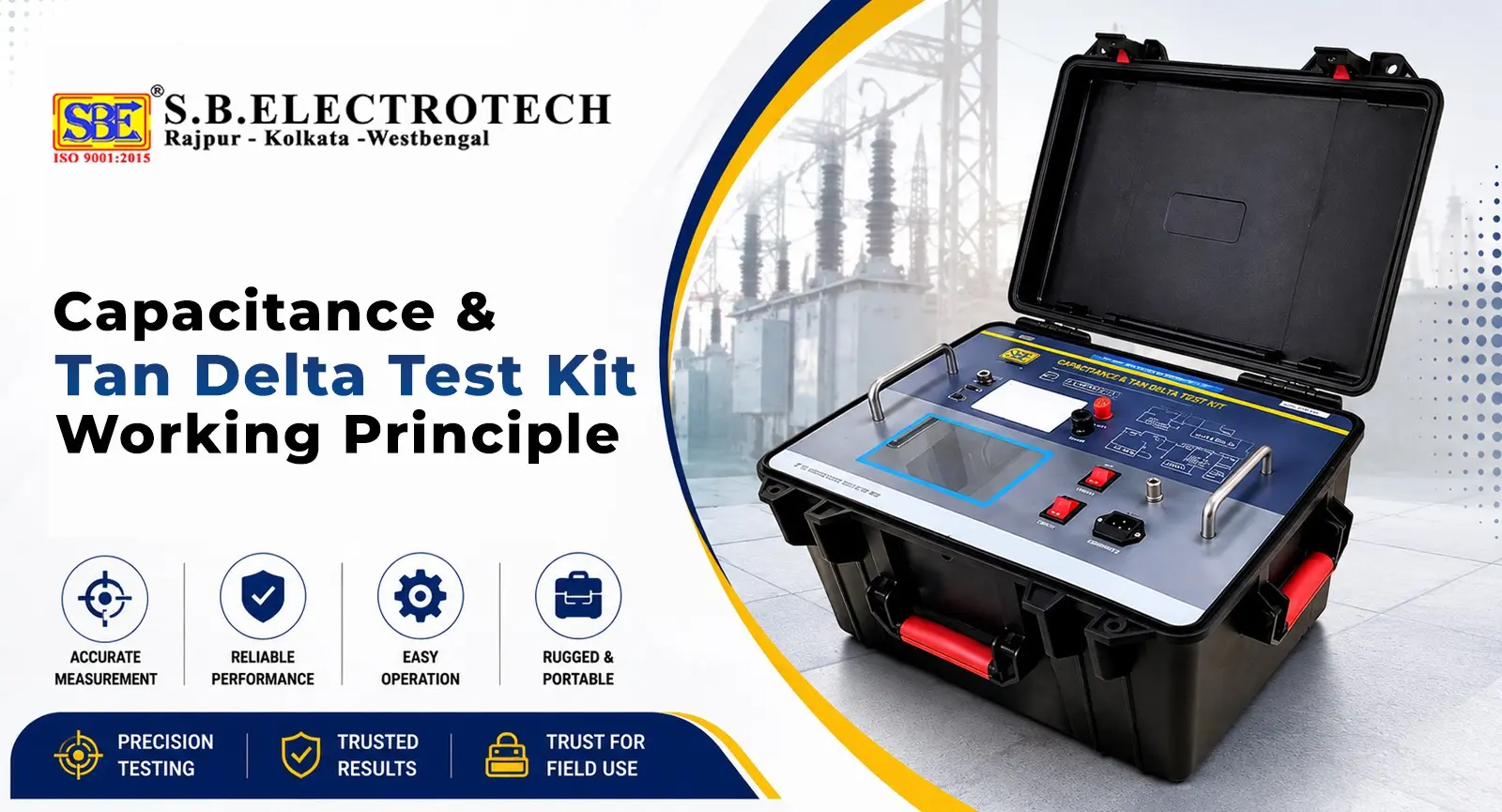
Introduction
A transformer doesn’t usually fail without warning. It fails after years of invisible decline, moisture working its way into the paper insulation, oil slowly oxidising, and tiny energy losses building up cycle after cycle until one day, they don’t stay tiny anymore. The frustrating part has always been catching that decline early enough to do something about it.
This is exactly where a capacitance & tan delta test kit is used. Rather than waiting for a visible fault or relying on a basic insulation resistance check that only tells you ‘pass’ or ‘fail’, this test measures subtle electrical movement that shifts as insulation ages, turning something invisible into a number you can track. This article gets into how the kit does that measurement, what the numbers mean, and how to run the test so the results hold up.
What Is a Capacitance & Tan Delta Test Kit?
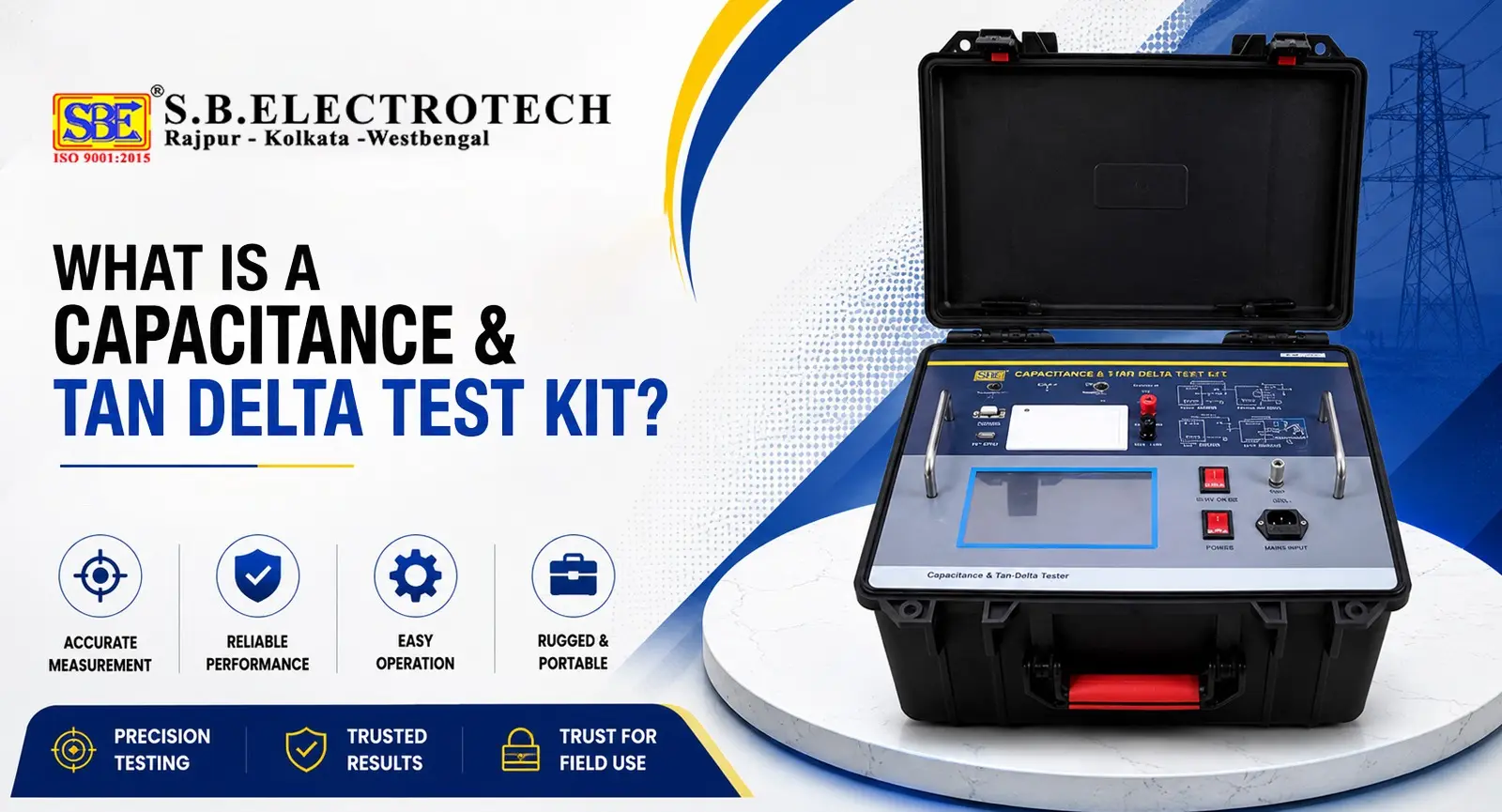
This is a portable diagnostic instrument that applies a controlled AC voltage, usually somewhere between 0.5 and 12 kV, to the insulation you’re testing and measures how it responds.
- Capacitance tells you how well the insulation stores electrical charge, and changes here can point to physical displacement, moisture, or shifts in geometry.
- Tan delta, also called dissipation factor or power factor, tells you how much energy is being lost as heat instead of stored properly, expressed as the ratio between resistive current and capacitive current.
Together, these two readings build a picture of whether insulation is dry and healthy, or quietly heading toward trouble.
How does the Kit Applies Voltage and Reads the Result?
Inside a typical capacitance & tan delta test kit, a stable AC high-voltage source generates the test voltage, often selectable between something like 2 kV, 5 kV, and 10 kV. That voltage gets applied between the equipment under test, say a high-voltage winding, and ground or another winding, depending on the connection mode the test calls for.
Precision current sensors pick up the total current flowing through the insulation, which needs to be sensitive enough to resolve currents in the microamp to milliamp range, since tan delta values often fall somewhere between 0.001 and 0.02.
From there, the kit samples both voltage and current waveforms at the same time and works out the phase angle between them, usually through digital signal processing. That phase angle lets it separate the current into its capacitive and resistive parts and, from there, calculate both capacitance and tan delta directly. A good modern capacitance & tan delta test kit can resolve tan delta down to 0.001%, precise enough to catch changes in insulation condition well before they’d show up any other way.
Guarding and Keeping Field Interference Out
Field conditions are rarely clean. Nearby energised equipment, surface leakage on a dirty or damp bushing, and stray ground loops can all throw off a reading if the kit isn’t built to handle them.
- Guard terminals route surface leakage current away from the measurement, so what you’re reading is the insulation itself, not moisture on the outside of a bushing.
- Filtered or variable-frequency sources help avoid interference from mains harmonics that would otherwise distort the signal.
- Shielded cables and proper grounding cut down on external coupling that could quietly skew the result.
This is the difference between lab-grade accuracy and a capacitance & tan delta test kit; you can’t trust once you’re out on site.
Where This Test Gets Used
This kind of testing shows up across a fairly wide range of high-voltage equipment. Power transformers get tested across HV-LV, HV-ground, and LV-ground configurations to check both the windings and the oil-paper insulation. Bushings, whether oil-impregnated paper, resin-impregnated paper, or condenser-type, get evaluated for grading layer faults and moisture ingress. High-voltage cables, current transformers, potential transformers, rotating machines, and switchgear all rely on the same underlying principle wherever insulation conditions need checking. In every case, it’s a non-destructive test, fitting naturally into commissioning, major maintenance work, or an ongoing condition-monitoring programme.
Getting Reliable Results in the Field
A sensitive capacitance & tan delta test kit still needs a disciplined process behind it to deliver the data. Isolate and fully discharge the equipment before testing, and remove temporary grounds only according to the test scheme you’re following. Record oil or winding temperature and correct tan delta back to a reference point, often 20°C, so results stay comparable across different test dates.
Use guarding properly, especially on dirty or humid bushings where surface leakage is more likely to distort things. Run the test across multiple voltage steps to catch any non-linear activity that a single voltage wouldn’t reveal. And always compare against a baseline, whether that’s factory data or a previous test, since a number without that context doesn’t tell you much on its own.
Conclusion
Understanding the Capacitance & Tan Delta Test Kit isn’t just theory for engineers; it directly shapes how confidently you can trust ageing insulation before it fails in the field. Once you know what the readings reveal, decisions around maintenance schedules and replacement timing get a lot easier to justify. At SB Electrotech, test kits are built to give accurate, repeatable readings plant teams can rely on, so insulation problems get caught on paper long before they turn into costly downtime.
FAQs

S.B.ELECTROTECH
S.B. Electrotech is a company that specializes in manufacturing of electrical and electronic testing and measuring instruments. With years of expertise in this field, we ensure to provide high quality, safe, and sustainable products.
